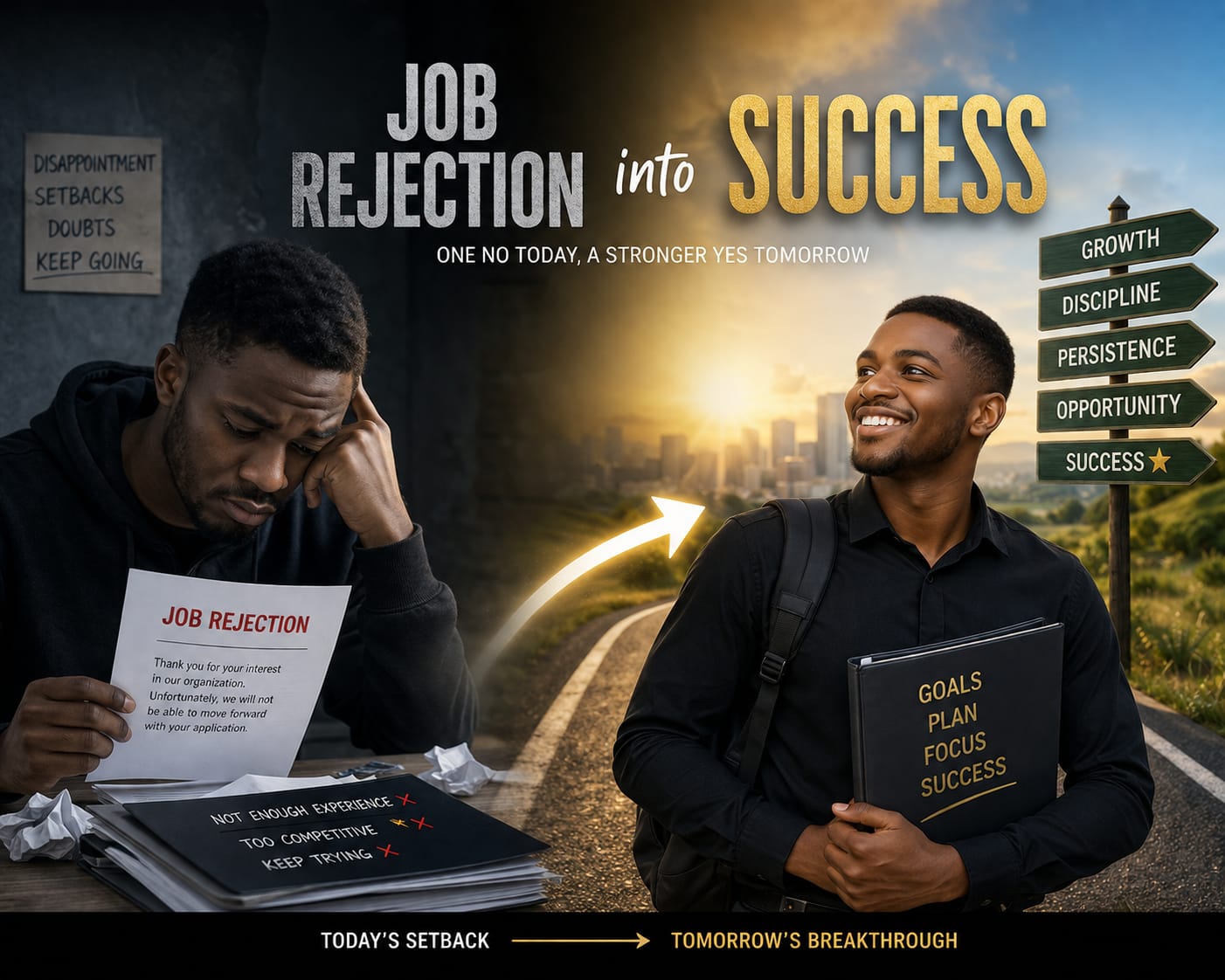
Job Rejection to Success: Turn Every No Into Your Next Yes (2026)
Job rejection is one of the most common experiences in South Africa's competitive job market. With youth unemployment reaching 56.3% among 18-34 year olds in early 2025, rejection is not personal – it's statistical . Recent research shows that in South Africa it may take graduates an average of nine job applications to secure employment, while some candidates may need 100 to more than 200 applications depending on their field .
This guide is designed to help you navigate job rejection, build resilience, and turn every "no" into a stepping stone toward your next opportunity. Drawing on South African research and global best practices, you will find practical strategies to manage the emotional impact of rejection, learn from setbacks, and stay motivated through a long job search.
What Job Rejection Really Means in South Africa
The Numbers Behind the "No"
South Africa's unemployment crisis makes rejection a shared experience rather than a personal failure:
Youth unemployment among 18-34 year olds reached 56.3% in early 2025
The expanded unemployment rate for young people has been on a downward spiral since 2015
Women are disproportionately affected, with consistently higher unemployment rates than men
Research shows: It can take an average of 9 applications for graduates to secure employment, but for many candidates, it takes 100 to more than 200 applications
The Psychological Impact of Rejection
A South African study explored the psychological journey of youth moving from unemployment to employment . The findings show that:
Job seekers often experience a loss of identity caused by repeated rejection
The lack of feedback from employers can lead to feelings of invisibility and self-doubt
Emotional exhaustion from constant rejection is common
Key insight: The psychological factors influencing employment success are often overlooked, yet they play a crucial role in determining who eventually secures work .
Step-by-Step: How to Handle Job Rejection
Step-by-Step: How to Handle Job Rejection
Job rejection can lead to feelings of disappointment, sadness, frustration, anxiety, self-doubt, and low self-esteem .
What to do:
Remind yourself that your emotions are valid and understandable based on the situation
Give yourself permission to feel the emotions for a reasonable amount of time
Express your emotions to trusted loved ones who are skilled at providing emotional support
Consider journaling as a mindfulness technique to understand and navigate the various emotions that may present
Remember: Ignoring your emotions doesn't make them disappear. Acknowledging them is the first step to moving forward.
Step 2: Reframe Your Thoughts and Cultivate a Growth Mindset
After being rejected, it can be easy to internalise failure by resorting to negative thinking. Thoughts like "I am not good enough" or "I won't be able to find a job" can become overwhelming .
What to do:
Remind yourself that your thoughts are not facts – they are just thoughts
Replace negative, unrealistic, or irrational thoughts with more realistic, rational, constructive ones
Ask yourself: "What can I learn from this experience to improve myself for the future?"
View each rejection as feedback, not failure
"Rejection isn't the end. It's redirection. Sometimes the no's are leading you straight into the yes that was always meant for you." — Fhumalani Netshirenwe, RCL Foods
Step 3: Ask for Feedback
One of the most valuable steps after rejection is to ask for feedback. Not every employer will respond, but those who do can offer invaluable insights .
How to ask for feedback:
Send a polite, professional reply to the rejection email
Thank them for their time and the opportunity to interview
Ask specifically: "If you have a moment, I would be grateful for any feedback that could help me improve in my job search"
Show maturity and a commitment to professional growth
Important: Do not argue with the feedback. Use it as information to help you improve .
Step 4: Reflect and Evaluate
Once you've had time to process the rejection, resist the urge to dismiss it and move on too quickly. There is a lot to learn from the experience .
Questions to ask yourself:
What went well during the interview process?
What could I have done better?
Did I adequately prepare for technical questions?
Did I effectively build rapport with the interviewer(s)?
Did I strike the right balance between technical expertise and soft skills?
Were there questions I struggled to answer confidently?
Pattern recognition: Think about previous rejections, performance reviews, or feedback you've received in past roles. Do you notice recurring themes? These patterns can help you identify the skills or qualities you need to strengthen .
Step 5: Create a Development Plan
Use rejection as motivation to improve your skills .
Areas to focus on:
Interview skills: Rehearse common questions with a friend or mentor. Focus on telling clear, concise stories about your accomplishments
Technical skills: If you identified a skill gap during the interview, look for online courses, certifications, or workshops to fill it
CV and cover letter: Based on the roles you're applying for, tweak your CV to better highlight your most relevant skills and experiences
Personal development: Enrol in relevant training, seek mentorship, or practice interview responses with a career coach
Remember: Every step you take to improve your skills brings you closer to your dream role .
Step 6: Leverage Networking and Connections
Networking is a crucial asset for any candidate. Building strong connections can enhance your skills, keep you informed about industry trends, and introduce you to potential mentors, partners, and clients .
How to network effectively:
Build genuine relationships – networking is a two-way street
Be authentic, follow up, and stay in touch
If you get rejected, stay professional and positive
Leave a lasting, positive impression to keep the door open for future opportunities
Stay connected with the company on LinkedIn and engage with their content
Pro tip: Even if you weren't hired, you can still build a valuable professional relationship with the interviewers and hiring managers you met .
Step 7: Stay Positive and Persistent
Job hunting is tough, and it is important to remember that each rejection is a step closer to the right opportunity .
Strategies to stay positive:
Create a constructive daily routine that promotes a sense of purpose
Invest in daily mental health-enhancing habits: sleep, nutrition, hydration, physical activity, and relaxation
Reach out to important support systems
Remind yourself that rejection is normal – it is not a sign of failure but of redirection and progress
Practice mindfulness to manage job search stress
"Your life should always be the number one priority, even during a job search. Remember to recharge your batteries from time to time and practice mindfulness to manage job search stress effectively." — JobLeads expert
Real Stories of Rejection to Success
Fhumalani Netshirenwe: The Application That Changed Everything
Fhumalani Netshirenwe from Venda, Limpopo, applied for a job at RCL Foods on the closing day. She had been rejected so many times she was on the edge of giving up .
"I'd been rejected so many times, I was on the edge of giving up," she recalls. "I thought, what are the chances they'll even see my application, let alone consider me?"
She clicked 'apply' anyway. Just weeks later, she started as a Junior Business Analyst. Six months after that, she became permanent. Today, she is a successful professional with multiple certifications in analytics, SAP, Excel, and women's empowerment .
Rudzani Moralane: No One Would Hire Her, So She Hired Herself
Rudzani Moralane graduated with a Chemical Engineering qualification in 2011. Despite years of applications and volunteer work, no one would hire her .
She went back to studying, enrolling for an IT degree to improve her chances. She dropped out. The job market kept saying no .
Eventually, she stopped waiting. Drawing on her Chemical Engineering background, she started Roo Detergents in Pretoria, producing and packaging washing powders, soaps, and cleaning products. The business grew. It gave her hope again. Today, she supports her family and encourages other unemployed graduates to consider working for themselves .
Priscilla Ngwenya: From Rejection to Self-Employment
Priscilla Ngwenya, 35, came to Johannesburg from Zimbabwe in 2015 hoping for a better life. Despite her efforts, she did not secure any of the well-paying jobs she was hoping for .
After a long day of job hunting, she sat down and reflected. Her passion for baking reignited. She decided to bake and sell scones to make a living. She wakes up at 3am every day, bakes, and hits the streets of Joburg at 6am with fresh scones. She earns a profit of R200 per day, enough to pay rent and buy groceries for herself .
Her advice to unemployed women: "Stay active, use your skills to earn money, and ensure your children don't go to bed hungry" .
Sasha Knott: Three Retrenchments and Rising
Sasha Knott, a seasoned recruiter and head of talent, has been retrenched three times. Each time, she thought experience would speak for itself. Each time, her applications went unanswered .
She learned that a job search strategy requires more than a great track record. She now shares practical, battle-tested advice for South African job seekers – including CV optimization for both recruiters and ATS systems, and why being retrenched isn't the end, but where a new story begins .
Tips for the Long Job Search
Apply strategically: Submit fewer, more targeted applications rather than mass applying
Customise your applications: Tailor your CV and cover letter for each job by reading the job description thoroughly
Build your online presence: Create and maintain a LinkedIn profile that is up-to-date with skills, experiences, and career goals
Keep learning: Industries change, so keep your skills up to date with online courses, workshops, or new software programs
Join support networks: Connect with other job seekers for emotional support and sharing opportunities
Consider alternative pathways: Explore learnerships, internships, volunteer work, or entrepreneurship as stepping stones
Seek mentorship: A mentor can provide guidance and encouragement through the job search process
Common Mistakes to Avoid
❌ Taking rejection personally: Rejection is about fit, not your worth
❌ Giving up after a few rejections: It can take 100+ applications to secure a job
❌ Not asking for feedback: You are missing valuable insights to improve
❌ Isolating yourself: Social support is essential for maintaining mental health
❌ Neglecting mental health: Job searching is stressful – prioritise your well-being
❌ Not refining your approach: Learn from each rejection and adjust your strategy
FAQ: Job Rejection in South Africa
Q: How many job applications does it take to get a job in South Africa?
A: Research suggests it may take graduates an average of nine applications to secure employment. However, some candidates may need 100 to more than 200 applications depending on the field and specific circumstances .
Q: How do I deal with rejection when I don't even get an interview?
A: Review your CV and cover letter – it may be a formatting or keyword issue. Consider using a CV review service or asking a trusted professional for feedback. Sasha Knott emphasises that CVs need to be optimised for both recruiters and ATS systems .
Q: What if I can't afford feedback services?
A: Use free resources: university career centres, online CV review tools, and networking with professionals in your industry. Join LinkedIn groups and ask for advice .
Q: How long should I wait before following up after a rejection?
A: You can thank the interviewer immediately after rejection. For feedback, wait a week or two before asking. Stay connected on LinkedIn and engage with the company's content .
Q: What if I keep getting rejected for the same reason?
A: Identify the pattern, then create a development plan. Take online courses, seek mentorship, or practice interview responses with a career coach .
Q: Should I accept a job below my qualifications?
A: Sometimes yes – a lower-level role can be a stepping stone. Many successful careers begin with foundational workplace experience .
Q: What if I can't afford further training?
A: Use free resources like YouTube tutorials, Coursera, or Google Digital Garage. Many free and low-cost learning options exist .
Conclusion
Job rejection is not the end of your career – it is part of the journey. In South Africa's competitive job market, rejection is a shared experience, not a personal failure. The key is to use each "no" as a stepping stone toward your next "yes."
The most successful professionals are not those who never faced rejection – they are those who learned how to respond to it. They asked for feedback, developed new skills, stayed connected, and kept moving forward despite the setbacks.
Every rejection is an opportunity to grow in self-awareness and perseverance. The more you learn from each experience, the better prepared you will be to land the right role .
Your next steps:
Process your emotions after rejection
Ask for feedback from the employer
Create a development plan to address skill gaps
Stay connected with your network
Keep applying – your next opportunity is out there
"You may not control the outcome, but you always control your response. And often, that's where the real success begins."
👉 Browse more job search guides on JoblySA – find advice on CV writing, interview preparation, and career development
👉 Join our WhatsApp group – get daily job alerts and career advice