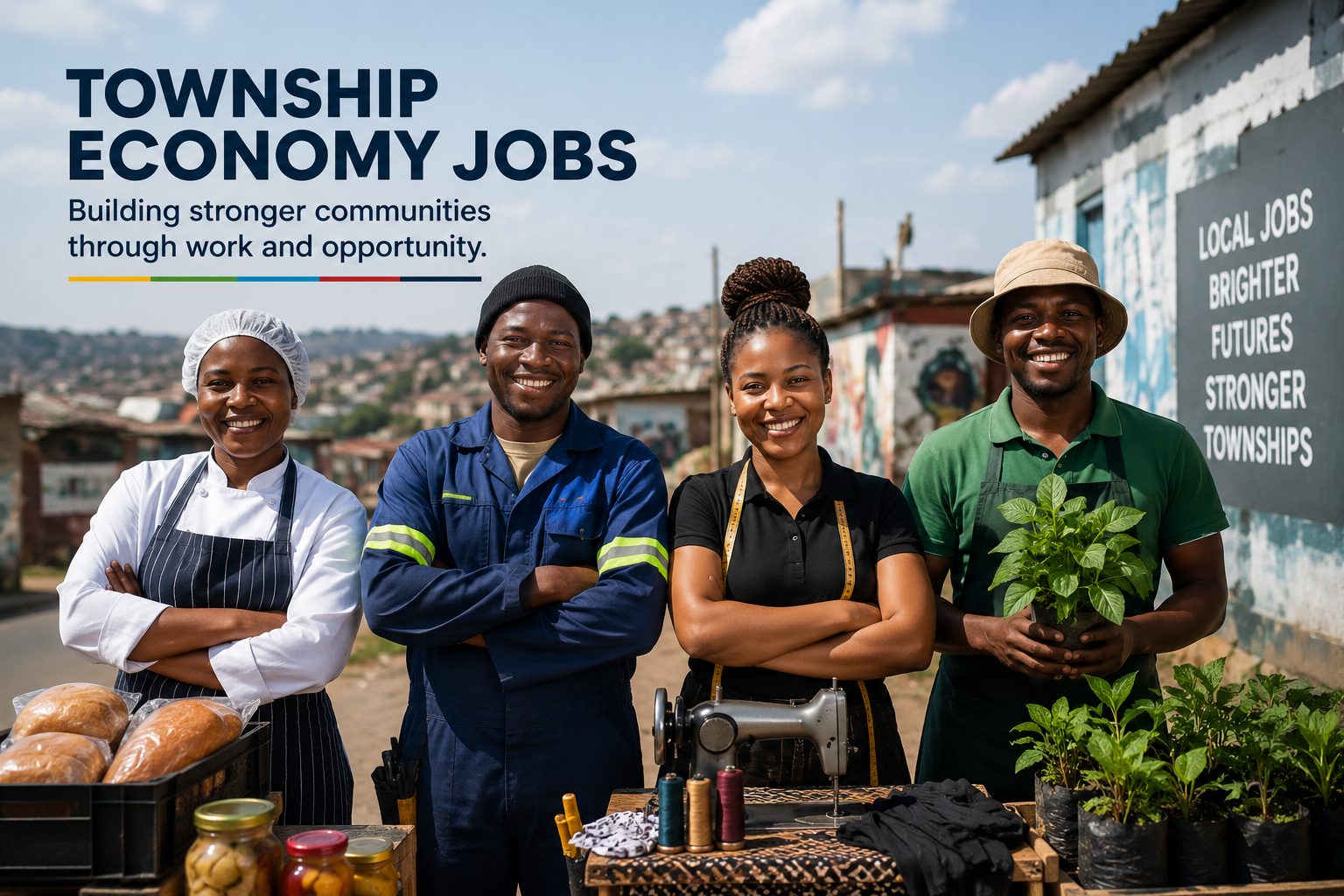
Township Economy Jobs — How Informal Sector Work Is Growing in SA
For decades, South Africa's townships were spoken about as places of consumption — where residents spent money earned elsewhere. That narrative has quietly reversed in 2026. The township economy is now one of the country's fastest-growing sources of new jobs, and for thousands of young South Africans who cannot find formal employment, it has become a genuine alternative.
Here is what is happening, where the opportunities are, and how you can be part of it.
The Numbers That Changed the Conversation
Statistics South Africa's first-quarter labour data for 2026 contained a surprising figure. While formal private sector employment grew by just 1.8% year on year, employment in the informal non-agricultural sector — dominated by township-based businesses — grew by over 11%. That translates to roughly 340,000 new positions, the vast majority of them in Soweto, Tembisa, Khayelitsha, Umlazi, and other major townships.
The shift has been driven by three forces. First, persistent youth unemployment in the formal sector has pushed young entrepreneurs to create their own work. Second, major retailers and manufacturers have begun treating townships as distribution and production hubs rather than just retail outlets. Third, government funding earmarked for township SMMEs has become more accessible and less bureaucratic than in previous years.
Where the Jobs Are Being Created
The old image of township work — a single spaza shop owner selling basics from a container — no longer reflects reality. The 2026 township economy is layered, connected, and increasingly specialised.
Spaza shop supply and logistics is one of the biggest growth areas. Large wholesalers have set up township-based distribution points, creating jobs for drivers, loaders, stock controllers, and last-mile delivery riders. The shift away from cash-and-carry trips to city centres has formalised what was once informal, with regular wages for many logistics workers.
Township manufacturing is another surprising success story. Small-scale bakeries, furniture makers, uniform sewers, and packaged food producers have multiplied, helped by lower rental costs and direct access to local customers. A single bakery in Diepsloot that started with two employees in 2023 now employs 17 people and supplies 22 spaza shops.
The night economy — shebeens, township restaurants (often called shisanyamas), and event spaces — has become more organised. Licensed establishments now require security, wait staff, cleaners, and social media managers. In Soweto's Vilakazi Street corridor alone, hospitality-related jobs have increased by an estimated 40% since 2024.
Taxi rank economies have also evolved. Major ranks in Tembisa and Nyanga now host clusters of phone repairers, clothing sellers, fast-food vendors, and money transfer agents who employ multiple staff — not just family members.
Government's Role in 2026
The Department of Small Business Development launched the second phase of the Township and Rural Entrepreneurship Programme (TREP) in February 2026, with a significantly simplified application process. Instead of lengthy business plans, applicants can submit a one-page proposal and three months of bank statements. Grants range from R15,000 for micro-enterprises to R250,000 for established township businesses that can demonstrate job creation.
The department has also partnered with eight township business hubs that offer free registration assistance, basic bookkeeping training, and help with supplier contracts. These hubs are now operating in every metropolitan municipality.
Critically, the South African Revenue Service (SARS) introduced a simplified turnover tax window specifically for first-time informal sector registrants in 2026. Township business owners who earn below R335,000 per year can register online in under 10 minutes without needing a tax practitioner.
The Permit Challenge — And a Solution
One of the longest-standing barriers to township economy jobs has been local municipality trading permits. Many informal operators worked without permits because the process was slow, expensive, or openly hostile.
In response, several metros have introduced fast-track informal trading permits in 2026. The City of Johannesburg now processes spaza and street trader permits within 14 days at a cost of R350. Ekurhuleni has gone further, waiving permit fees for first-time applicants under the age of 35. These changes have brought an estimated 12,000 informal businesses into the compliant economy since January.
However, challenges remain. Permit enforcement is still uneven, and some municipalities have not reformed their systems. If you operate without a permit where one is required, you remain vulnerable to fines or confiscation of goods.
How to Find Township Economy Jobs
Unlike formal jobs listed on LinkedIn or Indeed, township jobs are rarely advertised online. The most effective methods remain local networks and direct engagement.
If you are looking for work, visiting spaza shop supply depots, taxi rank markets, and busy trading strips in person — and asking managers directly — still works better than any online application. Township business hubs also maintain informal job boards that are not published on the internet.
If you want to start a business, the most viable entry point in 2026 is not opening a new spaza shop — the market is saturated — but supplying existing ones. Small-scale production of bread, ice, cool drinks, airtime vouchers, or cleaning products for township retailers has lower risk and more predictable income than direct retail.
What Township Economy Workers Must Know
Just because work is informal does not mean you have no rights. The National Minimum Wage applies to domestic workers, farmworkers, and many informal sector roles, though enforcement in townships remains inconsistent. The Department of Employment and Labour has deployed mobile inspection units to major township trading areas in 2026, but coverage is not yet comprehensive.
Workers should also understand that informal employment does not automatically mean no UIF registration. Employers with one or more employees are technically required to register for UIF, although compliance in the township economy is low. The best advice is to ask about UIF during any employment discussion and to keep your own records of hours and pay.
For the most up-to-date information on township economy funding, permit changes, and local job hubs across Gauteng, Western Cape, KZN, and Eastern Cape, visit JoblySA.co.za regularly.